Quick picks
The edited three-piece shortlist
Start with the item that solves your biggest daily problem. Compare current dimensions, seller and availability on Amazon before ordering.
Vertical anchor
BAYKA 22.5-inch Floating Shelves
Best for: Owner-occupied kitchens, light storage
Check on Amazon (paid link)Optional hanging storage
Mkono mug holder rack
Best for: Light mugs, extra visual rhythm
Check on Amazon (paid link)Narrow brewer
Keurig K-Mini
Best for: Single-serve routines, narrow shelf bays
Check on Amazon (paid link)| Pick | Role | Best for |
|---|---|---|
| BAYKA 22.5-inch Floating Shelves | Vertical anchor | Owner-occupied kitchens, light storage |
| Mkono mug holder rack | Optional hanging storage | Light mugs, extra visual rhythm |
| Keurig K-Mini | Narrow brewer | Single-serve routines, narrow shelf bays |
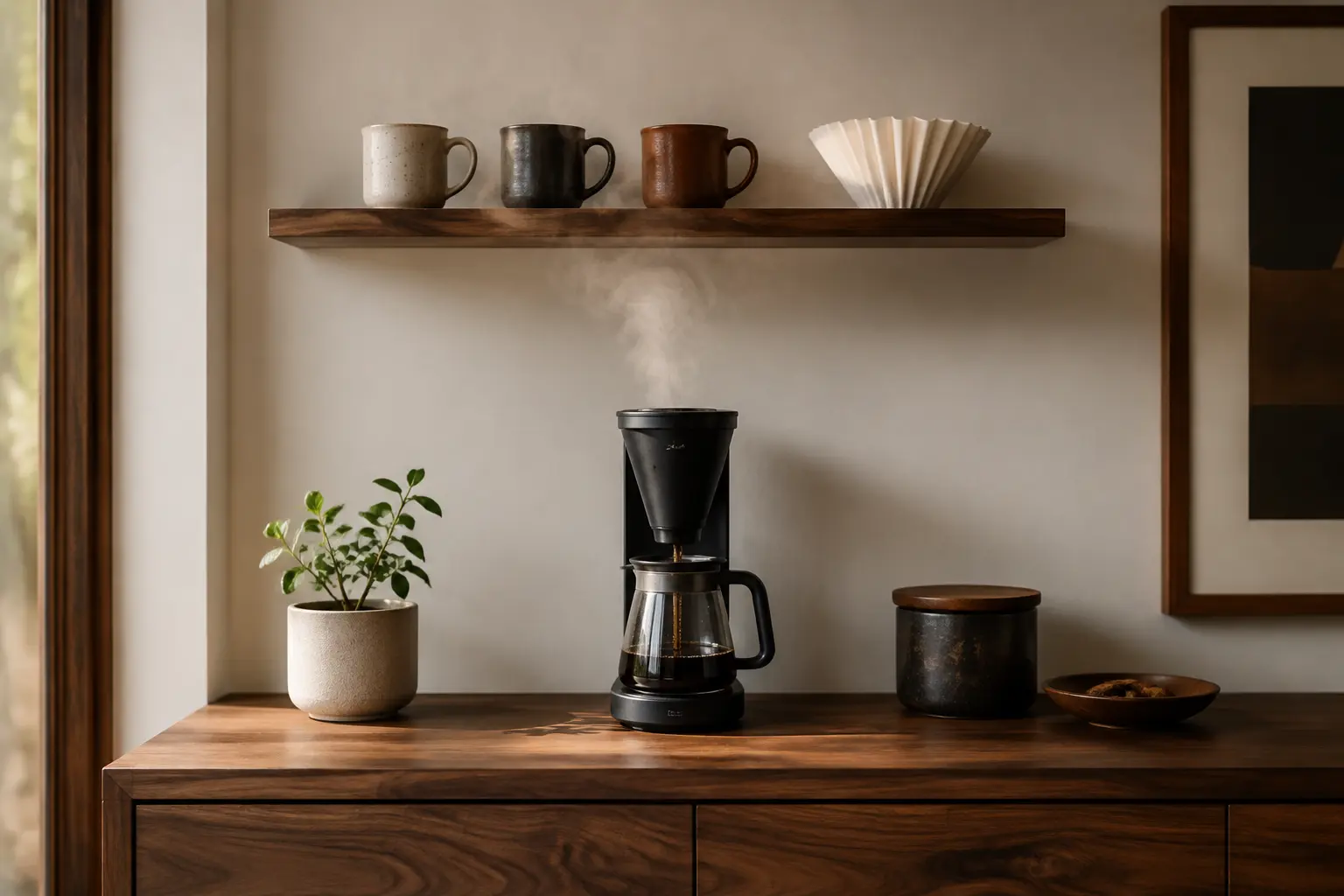
One shelf can make a coffee station feel intentional while moving mugs and filters off the counter. The critical detail is clearance: the machine still needs to open, vent steam and sometimes remove a water tank from the top.
Mock up the shelf height with painter's tape before drilling or buying brackets. Open every lid, remove every reservoir and rehearse the normal brewing motion. The attractive shelf line should support the routine, not interrupt it.
Plan the station before you shop
Measure the machine in motion
Record the tallest point with lids open and reservoirs being removed. Add comfortable hand clearance and follow the appliance maker's ventilation guidance.
Keep shelf loads light
Mugs, filters and a small coffee container make sense. Large water bottles, heavy appliances and crowded glass jars make the shelf less safe and the station visually top-heavy.
Align the visual edges
The shelf can match the station width or stop slightly inside it. Avoid a shelf that ends awkwardly through the middle of a machine or leaves a tiny unusable corner.
A focused equipment edit
These are starting points, not a requirement to replace gear you already own. Check the current listing, dimensions, compatibility and seller details before purchasing.
Vertical anchor
BAYKA 22.5-inch Floating Shelves
The shallow shelf set can hold light coffee-station essentials without projecting like a wall cabinet. Install only as many shelves as the layout needs, and verify the wall type, anchors and safe load first.
Best for: Owner-occupied kitchens, light storage
Optional hanging storage
Mkono mug holder rack
A wall or under-cabinet rail can move mugs off the counter. Only use it when cups stay clear of steam and the mounting system suits the surface.
Best for: Light mugs, extra visual rhythm
Narrow brewer
Keurig K-Mini
A narrow body leaves more side space under a compact shelf, but lid clearance still needs to be measured before installation.
Best for: Single-serve routines, narrow shelf bays
Make it feel intentional
Styling rules that still work at 7 a.m.
- Keep the shelf shallower than the counter so it does not feel like a cabinet.
- Display repeated shapes—two or three cups—rather than unrelated décor.
- Match one shelf tone to either the countertop or an existing wood finish.
Avoid the reset trap
Common mistakes
- Installing the shelf before testing lid and tank movement.
- Placing paper filters where kettle steam reaches them.
- Overloading decorative anchors or an unknown wall surface.
Save this list
Your five-point setup check
- Check appliance ventilation guidance
- Mock the shelf line with tape
- Open every lid and remove the tank
- Confirm wall and anchor type
- Keep heavy backup supplies elsewhere
Explore the idea