Quick picks
Three tools, from routine to deep clean
You may need only a dry brush. Add a purpose-made cleaner when the manual allows it and residue persists; check the current listing and directions before use.
Approved-path cleaner
Urnex Grindz Grinder Cleaning Tablets
Best for: Periodic dry cleaning, oily residue, inaccessible chutes
Check on Amazon (paid link)Detail brushes
OXO Good Grips Deep Clean Brush Set
Best for: Hopper edges, grounds bins, exterior crevices
Check on Amazon (paid link)Daily dry brush
Pallo GrindMinder Cleaning Brush
Best for: Loose grounds, grinder chutes, quick bag-to-bag care
Check on Amazon (paid link)| Pick | Role | Best for |
|---|---|---|
| Urnex Grindz Grinder Cleaning Tablets | Approved-path cleaner | Periodic dry cleaning, oily residue, inaccessible chutes |
| OXO Good Grips Deep Clean Brush Set | Detail brushes | Hopper edges, grounds bins, exterior crevices |
| Pallo GrindMinder Cleaning Brush | Daily dry brush | Loose grounds, grinder chutes, quick bag-to-bag care |
A grinder can look clean while yesterday's coffee remains packed behind the burrs. Loose grounds turn stale quickly, and the thin film of oil left by darker roasts can make a fresh bag smell oddly flat. Cleaning helps, but this is one appliance where enthusiasm with soap and water can create a much larger problem.
The safest rule is simple: begin with the manufacturer's manual. Burr carriers, calibration systems and approved cleaning products vary. The routine here covers the dry maintenance common to many home burr grinders; when your manual disagrees, the manual wins.
The safe cleaning order
Unplug, empty and document
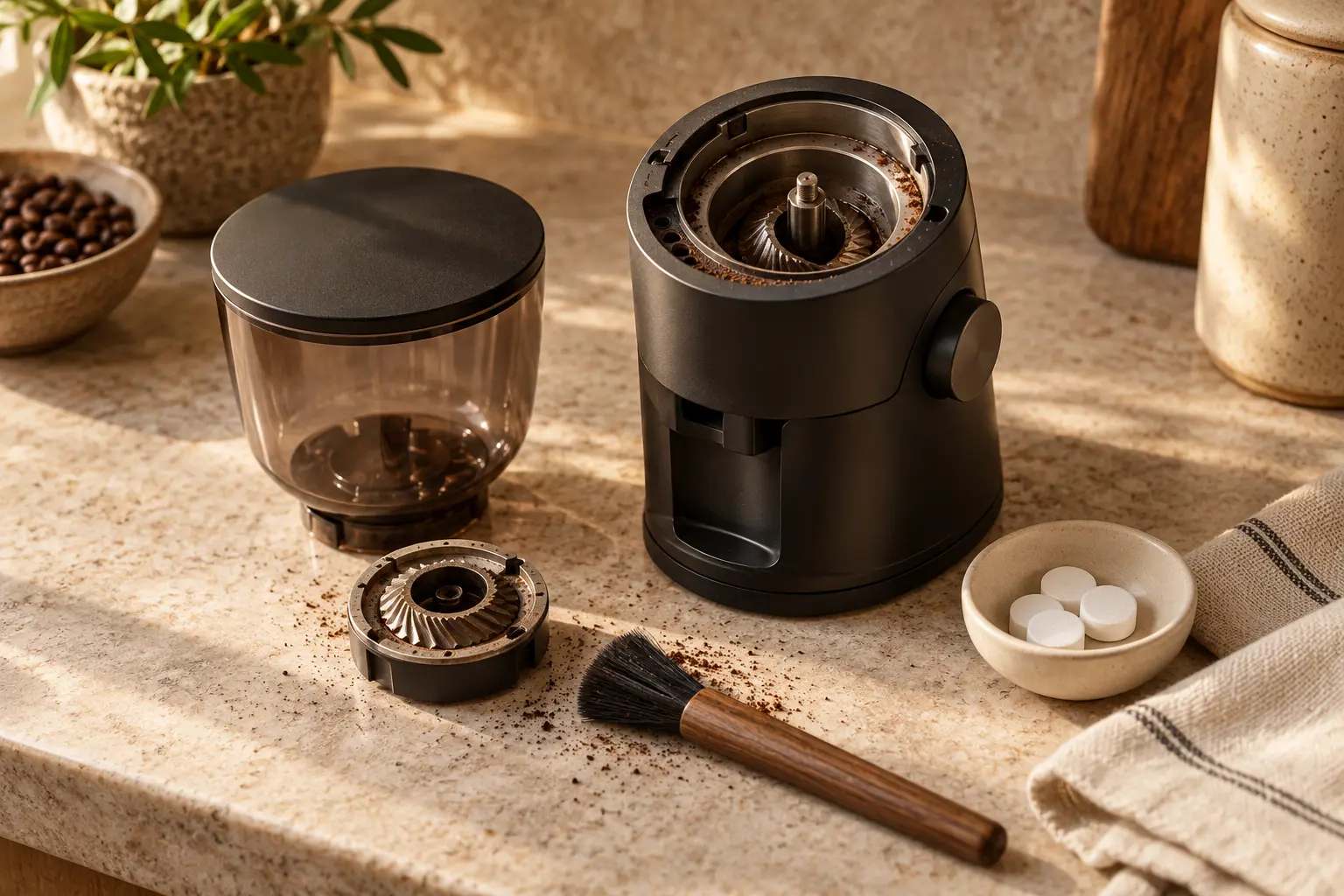
Disconnect the grinder before removing anything. Empty the hopper, run the machine only if the manual recommends doing so to clear retained beans, then unplug again. Take a quick photo of alignment marks and note the grind setting before lifting a removable upper burr.
Brush rather than rinse
Use a soft, dry brush to loosen grounds from the upper burr, chute and accessible ledges. Turn the grinder gently so debris falls out instead of being pushed deeper. Never introduce water to a burr chamber, motor housing or electrical contact. Wash only parts the manual explicitly describes as washable.
Reassemble and purge
Return every gasket, burr and hopper to its original position and confirm that alignment marks lock correctly. If you used approved grinder-cleaning tablets, grind a small sacrificial dose of coffee afterward and discard it. Listen for unusual rubbing before returning to a fine setting.
What to clean after each bag
The useful maintenance rhythm is tied to the coffee you use, not a perfect calendar. After finishing a bag, brush the empty hopper neck and wipe the grounds bin. Check the chute for compacted coffee. If you switch from a flavored or very oily dark roast to a delicate light roast, clean before the switch so the old aroma does not follow you.
A dry microfiber cloth is enough for most external surfaces. For a removable plastic hopper that the manual permits you to wash, use mild soap, rinse well and let it dry completely before reinstalling. A single hidden droplet near the burrs is not worth rushing the drying time.
When a deeper clean is worth doing
Deep-clean when grind output becomes clumpy without a humidity change, the grinder smells stale while empty, or grounds collect in places a normal brush cannot reach. Heavy espresso use and oily coffee usually demand more attention than an occasional filter brew. The goal is not to make the inside look factory-new; it is to remove residue without disturbing calibration or wiring.
Some grinders allow the upper burr to lift out without tools. Others require disassembly that should be left to a technician. Do not remove screws simply because an online video shows a similar model. Small design revisions can hide springs, washers or calibration shims that are easy to misplace.
Cleaning tablets: useful, but not universal
Purpose-made grinder tablets such as Urnex Grindz are designed to travel through a grinder and absorb coffee oils without taking the burr set apart. They can be genuinely useful for inaccessible pathways. They are not permission to ignore the appliance instructions: confirm that your model and burr type allow them, use the stated amount and purge as directed.
The familiar rice shortcut is not equivalent. Uncooked rice can be harder than a grinder was designed to process and may leave starch behind; some manufacturers explicitly advise against it. Instant rice appears in some older home methods, but there is little reason to improvise when a brush and an approved product are available.
How to tell whether cleaning solved the problem
After reassembly, set the grinder slightly coarser than your normal setting and grind a small dose. The sound should be steady, the adjustment should move normally and there should be no metal-on-metal scraping. Throw away the first coffee if it carried cleaner or loosened stale grounds.
If the grinder still stalls, produces a burning smell, changes pitch suddenly or refuses to adjust, stop using it. Those symptoms point beyond routine cleaning. Check the manufacturer support page or arrange service rather than repeatedly switching the motor on against an obstruction.
A small, sensible cleaning kit
These are starting points, not a requirement to replace gear you already own. Check the current listing, dimensions, compatibility and seller details before purchasing.
Approved-path cleaner
Urnex Grindz Grinder Cleaning Tablets
Food-safe tablets made to remove coffee particles and oils while passing through a grinder. They are convenient for burr pathways a brush cannot reach, provided your grinder manufacturer permits their use.
Best for: Periodic dry cleaning, oily residue, inaccessible chutes
Detail brushes
OXO Good Grips Deep Clean Brush Set
Two narrow household brushes for seams, corners and removable bins. Keep them dry around the burr chamber and reserve one for coffee so kitchen grease never reaches the grinder.
Best for: Hopper edges, grounds bins, exterior crevices
Daily dry brush
Pallo GrindMinder Cleaning Brush
A dual-ended brush combines softer bristles for loose grounds with a stiffer end for the grinder work surface. Keep it dry and use it only where the grinder manual permits.
Best for: Loose grounds, grinder chutes, quick bag-to-bag care
Make maintenance easy
Habits that prevent stale buildup
- Keep one grinder brush for coffee only.
- Take a phone photo before removing an aligned burr.
- Tie deeper cleaning to finishing a bag rather than an arbitrary date.
Protect the burrs
Shortcuts that can damage a grinder
- Rinsing a burr or chamber that the manual says to keep dry.
- Using uncooked rice as a homemade cleaner.
- Forcing a burr carrier that is not aligned.
Good questions
What people usually ask
How often should I clean a burr coffee grinder?
Brush loose grounds whenever they build up and consider a deeper clean after several bags, sooner with oily or flavored coffee. Usage matters more than a fixed monthly rule. A stale smell, clumping or a blocked chute is a better signal.
Can I wash coffee grinder burrs with water?
Usually you should not. Water can cause corrosion and can reach bearings or electrical parts. Some removable components may be washable, but only follow the instructions for your exact model and dry approved washable parts completely.
Can I use rice to clean my grinder?
It is safer not to. Raw rice may strain the motor or burrs and can leave starch in the grinder. Use a dry brush or a purpose-made cleaning product that your grinder manufacturer approves.
Save this list
The safe-clean checklist
- Read the model manual
- Unplug the grinder
- Photograph alignment marks
- Brush accessible parts dry
- Purge and listen
Fact-check notes
Technical details in this guide were checked against these first-party references.
Explore the idea