Quick picks
Three containers for one open bag
A canister slows exposure; it does not make stale coffee fresh. Choose capacity for the amount you really buy and check current product details.
Counter-worthy seal
Fellow Atmos Vacuum Canister
Best for: Bright counters, whole beans, smaller bags
Check on Amazon (paid link)Adjustable inner lid
Airscape Coffee Canister
Best for: Daily brewers, changing volume, cabinet or counter
Check on Amazon (paid link)One-hand access
OXO Steel Coffee POP Container
Best for: Tidy counters, frequent use, familiar closure
Check on Amazon (paid link)| Pick | Role | Best for |
|---|---|---|
| Fellow Atmos Vacuum Canister | Counter-worthy seal | Bright counters, whole beans, smaller bags |
| Airscape Coffee Canister | Adjustable inner lid | Daily brewers, changing volume, cabinet or counter |
| OXO Steel Coffee POP Container | One-hand access | Tidy counters, frequent use, familiar closure |
Coffee storage becomes décor very quickly: a row of labeled jars, a scoop on a hook and three half-open bags behind them. Freshness needs something simpler. Keep coffee sealed, dry and away from heat and light, then buy an amount that fits the pace of the household.
The original bag is not a failure of styling. If it has a reliable resealable closure and an opaque, protective construction, it may be the best container in the kitchen. A canister earns space when it improves the seal, shields a bright counter or makes one frequently used bag easier to handle.
Protect coffee without crowding the station
Choose the location first
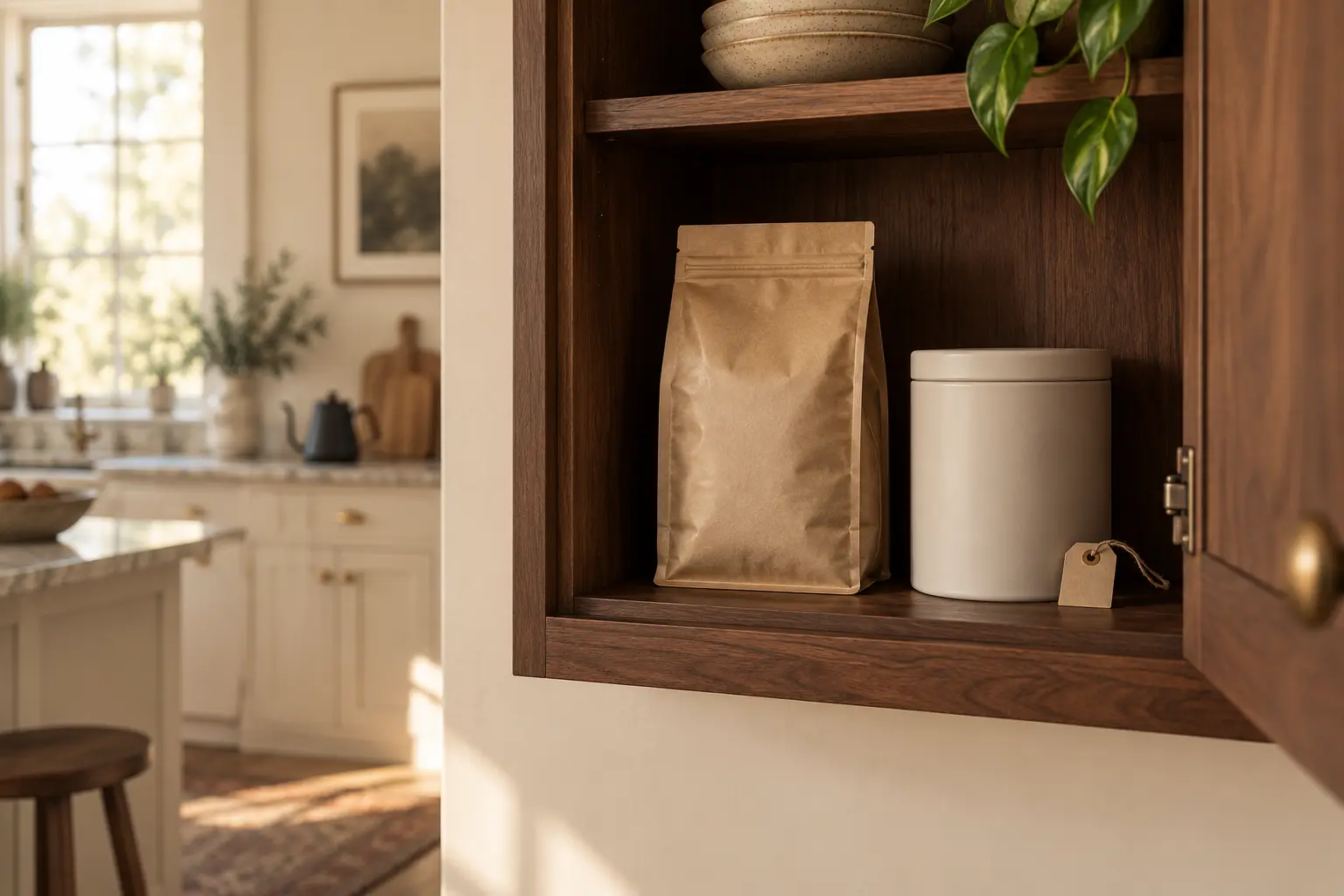
A cabinet away from the oven, kettle steam and direct sun gives the bag a stable home. Do not solve bright-counter exposure by buying a clear decorative jar.
Keep or improve the seal
Press excess air from a resealable bag before closing it. Move coffee to an opaque airtight canister only when the bag will not reseal or the container genuinely makes daily use easier.
Match volume to the routine
Buy a bag you can finish while its aroma still feels alive. An oversized canister with a small amount of coffee leaves a large air space and encourages bulk buying that may not suit one-cup mornings.
Bag, cabinet or canister?
A good original bag inside a cabinet combines two useful layers: the bag limits exposure each time it closes, while the cabinet blocks light and keeps packaging out of sight. Write the roast date or opening date where it remains visible rather than discarding the label.
An opaque canister is useful on an exposed counter or when a weak bag closure causes daily frustration. Choose a capacity close to the bag size you actually buy. Wash and dry the container completely before changing coffees so old oils and trapped moisture do not follow the new beans.
The pretty places are often the warm places
Coffee should not sit beside a kettle, above a dishwasher vent or in direct afternoon sun. Those locations may complete the visual triangle of brewer, beans and cups, but they expose the bag to repeated heat or moisture.
Move the coffee one arm's reach into a cabinet and keep only the dose in use on the counter. That tiny inconvenience protects both freshness and negative space. If the cabinet itself becomes warm from a nearby appliance, choose another one.
Do not lose the information on the bag
Before decanting, photograph the roast date, origin, process and brew notes. Keep the bag until the canister is empty if the coffee is new to you. Those details explain why one bag tasted wonderful and another did not; a handwritten label saying 'beans' explains nothing.
Use one-open-bag rule unless you intentionally compare coffees. Multiple open bags are harder to finish and easier to forget. If variety matters, buy smaller bags or freeze well-sealed portions according to the roaster's guidance rather than opening everything at once.
Canisters that earn their footprint
These are starting points, not a requirement to replace gear you already own. Check the current listing, dimensions, compatibility and seller details before purchasing.
Counter-worthy seal
Fellow Atmos Vacuum Canister
A twist-to-seal opaque canister designed to reduce air around coffee. Choose a capacity close to the bag size you normally buy.
Best for: Bright counters, whole beans, smaller bags
Adjustable inner lid
Airscape Coffee Canister
The movable inner lid reduces the open space above a changing amount of beans and gives a clear cue that the supply is running low.
Best for: Daily brewers, changing volume, cabinet or counter
One-hand access
OXO Steel Coffee POP Container
A tinted container offers a visually quiet form and simple access. Compare current capacity with the unopened bag before buying.
Best for: Tidy counters, frequent use, familiar closure
One bag, one home
Freshness with less visual noise
- Keep one current coffee visible at most.
- Photograph the bag details before decanting.
- Choose a canister close to the backsplash color so it recedes beside the brewer.
Keep flavor out of the display
Storage habits that work against the coffee
- Displaying beans in a clear jar near sunlight.
- Keeping coffee beside kettle steam or oven heat.
- Opening several large bags without a plan to finish them.
Good questions
What people usually ask
Should coffee beans stay in the original bag?
They can. A well-sealed opaque bag stored in a cool, dry cabinet is a practical solution. Use a canister when it improves a poor seal, blocks light on an exposed counter or makes daily access easier.
Are clear coffee jars a bad idea?
Clear glass does not protect coffee from light. It may work inside a dark cabinet, but an opaque bag or canister is a better choice on a bright counter.
Should coffee beans go in the refrigerator?
For everyday use, a sealed container in a cool, dry cabinet avoids refrigerator moisture and odors. For longer storage, ask the roaster about freezing well-sealed portions and avoid repeated thawing.
Save this list
Your one-bag storage check
- Choose a cool dark location
- Check the bag closure
- Record roast and opening dates
- Use one open bag
- Buy a volume that matches the routine
Fact-check notes
Technical details in this guide were checked against these first-party references.
Explore the idea